Replacing windows in Phoenix typically cost in a range per window installed, depending on size, frame material, and glass package. A typical whole-home project runs from a budget level to a higher-cost premium range, with many Phoenix homeowners spending an amount near the local average for a multi-window replacement. Those numbers reflect local conditions: Phoenix labor rates run roughly 5% below the national average, which keeps installed costs meaningfully lower than coastal markets. The range is wide because window size, frame choice, and glass package each move the price substantially. If you want a number specific to your home, Az1builders offers free on-site estimates across the West Valley and Greater Phoenix area.
Table of Contents
- What does window replacement cost in Phoenix, broken down?
- What factors affect your window installation price most?
- Which window types and specs work best in Phoenix heat?
- How much can you save on cooling costs with new windows?
- How long does a window replacement project take?
- How do you choose the right window contractor in Phoenix?
- Should you replace all windows at once or phase the work?
- Sample Phoenix cost scenarios: budget, mid-range, and premium
- Az1builders can handle your window replacement from estimate to installation
- Key Takeaways
- What Phoenix contractors know that most guides skip
- Useful sources for verification and next steps
What does window replacement cost in Phoenix, broken down?
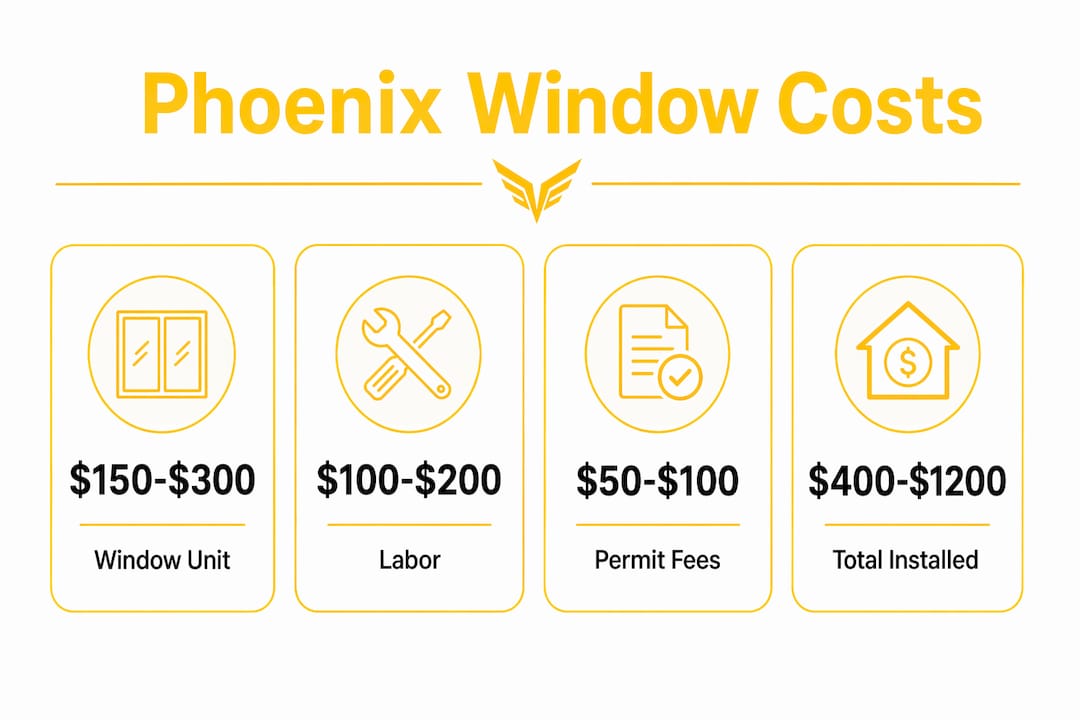
Understanding where your money goes makes it easier to evaluate bids and spot line items that seem off. The table below separates the main cost components for a standard double-hung replacement window at three price tiers.
| Cost Component | Budget | Mid-Range | Premium |
|---|---|---|---|
| Window unit (frame + glass) | $150–$300 | $300–$550 | $600–$900+ |
| Installation labor (per window) | $95–$285 | $95–$285 | $95–$285 |
| Trim, flashing, and sealing | $30–$60 | $60–$100 | $100–$150 |
| Disposal and cleanup | $15–$30 | $30–$50 | $50–$75 |
| Permit allowance (project total) | $150 | $150–$200 | $175–$300 |
| Installed total per window | $400 | $600–$900 | $1,200 |
Labor costs per window vary within a moderate range, and permit fees for a standard Phoenix replacement project are generally modest, depending on project valuation.
Worked example 1: single window replacement
A homeowner in Avondale needs one standard double-hung window replaced. Mid-range vinyl frame, double-pane Low-E glass, standard size (approximately 36″ x 48″):
- Window unit: $380
- Labor: $95–$285
- Trim and flashing: $75
- Disposal: $35
- Total: $675
No permit is required for a single like-for-like replacement in many Phoenix jurisdictions, but confirm with your city building department before scheduling.
Worked example 2: 15-window whole-home replacement
A typical single-family home in Surprise with 15 standard windows, mid-range vinyl frames, double-pane Low-E glass, and a project permit:
- Window units (15 × $420): $6,300
- Labor (15 × $95–$285): $1,425–$4,275
- Trim, flashing, and sealing (15 × $80): $1,200
- Disposal (15 × $40): $600
- Permit: $200
- Total: $10,925
That figure sits above the commonly cited Phoenix project average of $4,652 because it uses mid-range glass on every window. Choosing budget vinyl on secondary rooms and upgrading only south- and west-facing windows can bring the total closer to $4,000–$9,000 without sacrificing meaningful energy performance.
What factors affect your window installation price most?
Not every cost driver is within your control, but knowing which ones are gives you real leverage when comparing bids.
Factors you can control:
- Frame material. Vinyl is the most affordable and holds up well in desert heat. Fiberglass costs more but offers better dimensional stability. Wood requires more maintenance in Phoenix’s dry climate. Composite splits the difference.
- Glass package. Single-pane to double-pane Low-E is the single biggest performance upgrade. Adding argon fill costs modestly more and improves the U-factor further.
- Window size and style. Standard sizes cost less than custom or oversized units. Picture windows and fixed units are cheaper to install than casements or double-hungs with moving parts.
- Hardware and finish. Upgraded hardware and interior finishes add cost without affecting energy performance.
- Number of windows. Contractors often reduce the per-window price on larger projects because mobilization costs spread across more units.
Factors largely outside your control:
- Labor market rates. Phoenix labor runs below national averages, but rates shift with demand. Summer scheduling can tighten availability.
- Permit fees. Set by the city or county; budget $150–$300 for a typical project.
- Structural repairs. Rotted sills, damaged framing, or stucco repairs discovered during removal add cost that no estimate can fully predict until the old window is out.
Pro Tip: Stick to standard window sizes whenever your existing rough opening allows it. Custom sizing can add $100–$300 per window to the unit cost alone, and the energy performance difference is zero. Save the budget for a better glass package instead.
Phoenix’s monsoon season adds one cost driver many homeowners overlook: proper flashing and sill pan installation. Cutting corners on exterior sealing can void manufacturer warranties and cause water intrusion during heavy summer storms. Spend on installation quality, not just the window unit itself.
Which window types and specs work best in Phoenix heat?
Arizona’s climate is specific enough that generic window recommendations from national guides often miss the mark. The two performance numbers that matter most here are Solar Heat Gain Coefficient (SHGC) and U-factor.
SHGC measures how much solar heat a window lets in. In Phoenix, where cooling load dominates, a lower SHGC is almost always better. Target SHGC ≤ 0.25 for south- and west-facing windows. U-factor measures overall heat transfer; lower is better year-round. Aim for U-factor ≤ 0.30 for the Phoenix climate zone.
Glazing recommendations
Double-pane Low-E glass is the right baseline for nearly every Phoenix home. The Low-E coating reflects infrared heat before it enters the glass, which directly reduces the work your air conditioner does. Adding argon fill between the panes improves the U-factor further at a modest cost premium, typically $20–$50 per window. Triple-pane glass makes sense in very cold climates but offers diminishing returns in Phoenix, where heating load is minimal; the added weight and cost rarely pay back here.
Frame material in desert conditions
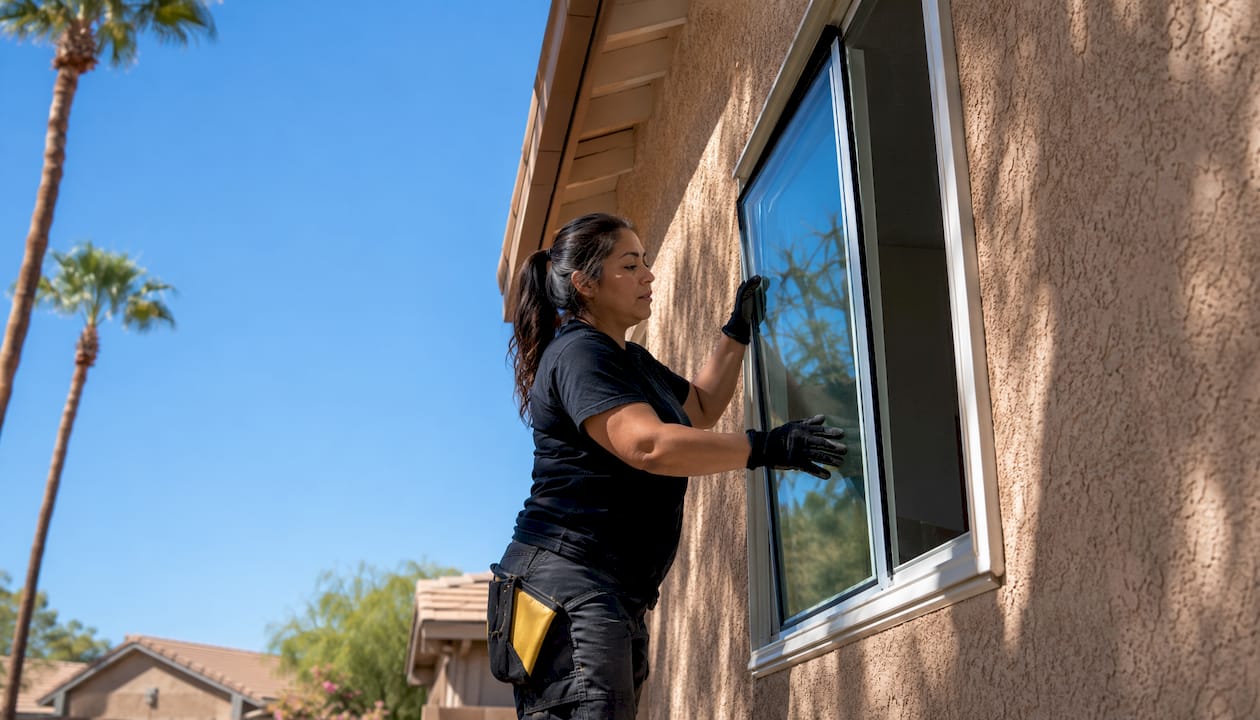
Vinyl frames are the practical choice for most Phoenix homeowners. They do not conduct heat the way aluminum does, they resist the UV degradation that shortens wood frame life in intense sun, and they cost less than fiberglass. Aluminum frames are common in older Phoenix homes and are durable, but their thermal conductivity works against you in summer. If you prefer aluminum for aesthetic reasons, look for frames with a thermal break. Fiberglass is the premium option: it expands and contracts at nearly the same rate as glass, which protects the seal over decades of Phoenix temperature swings.
How much can you save on cooling costs with new windows?
The energy savings from upgrading single-pane to double-pane Low-E glass are real and measurable in Phoenix’s climate, where air conditioning runs hard from April through October. A typical Phoenix home with single-pane windows can lose a significant portion of its cooling through the glass. Upgrading to double-pane Low-E with a low SHGC reduces that load materially, though the exact dollar savings depend on your home’s size, orientation, and current HVAC efficiency.
A reasonable working estimate for a mid-size Phoenix home: replacing 15 single-pane windows with double-pane Low-E units can reduce cooling-related energy use enough to lower monthly electric bills by $30–$60 during peak summer months. Over a full year, that adds up to $200–$400 in savings. At a mid-range project cost of roughly $9,000–$11,000, simple payback runs 22–55 years on energy savings alone, which is why incentives matter.
Rebates and incentives to check:
- APS (Arizona Public Service): Periodically offers rebates for qualifying energy-efficient window upgrades. Check the current APS rebate portal for active programs, as offerings change year to year.
- SRP (Salt River Project): Similar rebate programs for SRP customers; eligibility depends on window specifications and installation documentation.
- Federal tax credit: The ENERGY STAR program supports a federal tax credit for qualifying windows under the Inflation Reduction Act. Confirm current credit amounts with a tax professional.
Simple payback calculation (3 steps)
- Estimate annual savings. Multiply your estimated monthly cooling reduction by 12. Use your utility bills from the past two summers as a baseline.
- Subtract incentives. Deduct any utility rebates or federal tax credits from your total project cost to get your net investment.
- Divide net cost by annual savings. The result is your simple payback period in years.
For most Phoenix homeowners, the comfort improvement and reduced HVAC wear are as compelling as the energy math. A home that stays 5–8°F cooler near west-facing windows on a 115°F afternoon is a tangible quality-of-life gain that no spreadsheet fully captures.
How long does a window replacement project take?
Lead times and install duration vary more than most homeowners expect, and Phoenix’s climate adds scheduling considerations that other markets do not face.
Lead times: Stock vinyl windows in standard sizes are typically available within 1–2 weeks. Custom sizes, specialty shapes, or premium fiberglass frames can take 4–8 weeks from order to delivery. Factor that into your project timeline, especially if you are coordinating with other renovation work.
Installation duration: A single window replacement takes an experienced crew 1–3 hours, depending on accessibility and whether any framing repairs are needed. A full 15-window home replacement typically runs 2–3 days for a crew of two. Larger or more complex projects may extend to 4–5 days.
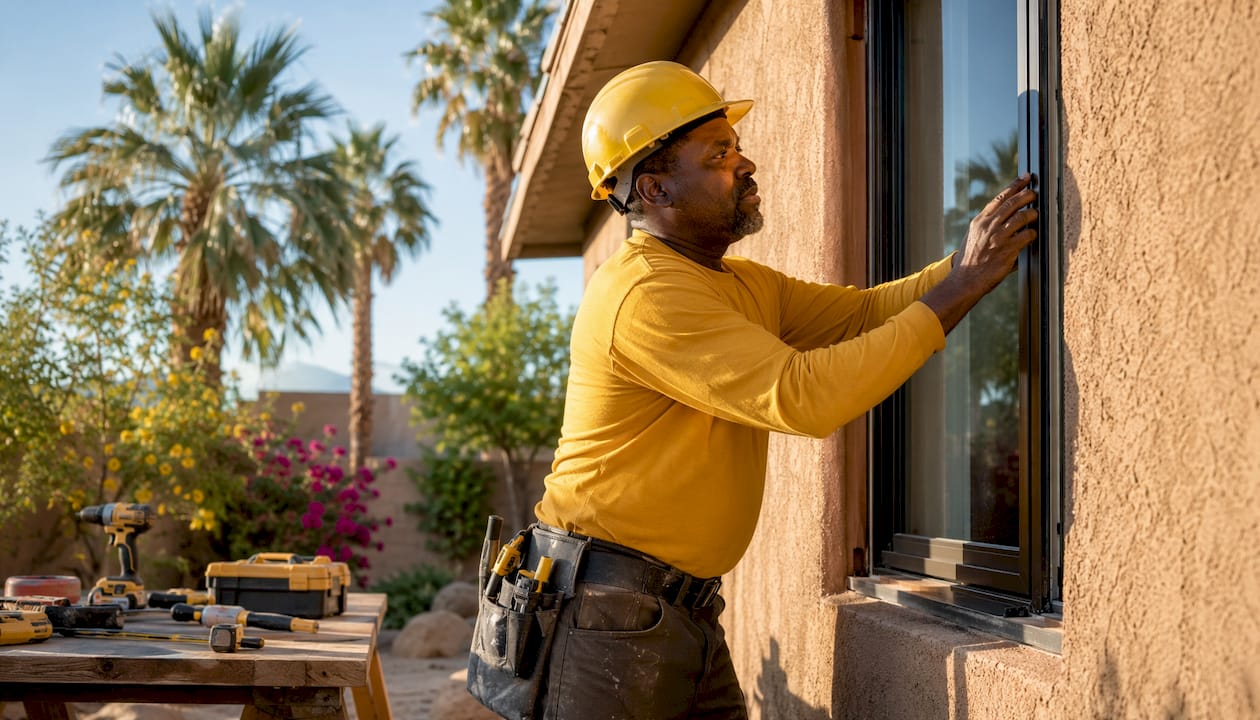
What happens on install day: The crew removes the existing window and inspects the rough opening for rot, damage, or out-of-square framing. They install the sill pan and flashing before the new window goes in, set and level the unit, secure it to the framing, seal the exterior perimeter, and finish the interior trim. Cleanup and debris removal happen at the end of each day on a professional job site.
Permit and inspection timing: Phoenix and most Valley cities require a permit for window replacements that change the opening size or structural configuration. Like-for-like replacements in the same rough opening may be exempt, but confirm with your city’s building department. Inspection scheduling typically adds 3–7 business days to the project close-out.
Seasonal scheduling: Avoid scheduling large exterior projects during July and August if possible. Extreme heat makes installation physically demanding and can affect sealant cure times. The window between late September and early May offers the most comfortable working conditions and often better contractor availability.
How do you choose the right window contractor in Phoenix?
The difference between a well-installed window and a problem one often comes down to the installer, not the product. Arizona has specific licensing requirements that protect homeowners, and verifying them takes less than five minutes.
License verification
All window replacement contractors in Arizona must hold a license from the Arizona Registrar of Contractors. You can search the ROC database by company name or license number at roc.az.gov. Confirm the license is active, covers the correct trade classification (residential contractor), and shows no unresolved complaints. This step is non-negotiable before signing any contract.
Questions to ask every contractor
- What is your ROC license number, and can I verify it?
- Do you carry general liability insurance and workers’ compensation? Can you provide certificates?
- Will you provide a written, line-item estimate that separates window cost, labor, trim, and permit?
- What is the installation method for flashing and exterior sealing?
- What warranty do you offer on labor, and what does it cover?
- What is the manufacturer’s warranty on the window unit, and who handles warranty claims?
- What is your timeline from order to installation completion?
Red flags to watch for
- A bid that is 30–40% below other quotes with no explanation of what was excluded.
- Vague warranty language (“we stand behind our work”) with no written terms or duration.
- A request for more than 10–15% upfront deposit before materials are ordered.
- No local references or verifiable project history in the Phoenix area.
- Pressure to sign the same day without time to review the written estimate.
Getting at least three written, line-item bids gives you a reliable price baseline and reveals which contractors are thorough enough to earn your trust.
Should you replace all windows at once or phase the work?
Both approaches are defensible, and the right answer depends on your budget, your home’s current window condition, and how you prioritize comfort versus cost.
Replacing all windows at once typically lowers the per-window cost because mobilization, permit, and setup costs spread across more units. You also get consistent performance across the whole home, a single warranty start date, and one disruption event instead of several. For homeowners whose windows are uniformly aging or failing, this is usually the more cost-effective path over a 5-year horizon.
Phasing the work makes sense when budget is the primary constraint or when only a subset of windows are failing. The practical staging strategy for Phoenix: prioritize south- and west-facing windows first, since those carry the highest solar heat gain and deliver the largest cooling-cost reduction per dollar spent. Replace windows with visible seal failure, condensation between panes, or damaged frames next, regardless of orientation.
One detail that matters when phasing: match the glass package across the same elevation. Mixing a low-SHGC window next to an older single-pane unit on the same west wall creates uneven thermal comfort and can cause your HVAC to cycle more than it should. Consistent SHGC values across exposed elevations produce noticeably more even interior temperatures.
Sample Phoenix cost scenarios: budget, mid-range, and premium
These three scenarios use consistent assumptions so you can map your home to the closest match and adjust from there.
Assumptions for all scenarios: Mid-market Phoenix labor rates, double-pane Low-E glass as the baseline, vinyl frames unless noted, permit included, standard-size windows (no custom sizing).
- Budget scenario: 10-window bungalow, vinyl frames, standard double-pane Low-E Per-window cost: $400–$1,200 installed. Total range: $1,900–$7,800. This fits a smaller older home with standard-size openings and no structural repairs needed. If any sills need repair, add more per affected window.
- Mid-range scenario: 15-window single-family home, vinyl frames, double-pane Low-E with argon Per-window cost: $400–$1,200 installed. Total range: $3,000–$8,000. This is the most common project type across the West Valley. The argon fill and slightly upgraded hardware account for the step up from the budget tier.
- Premium scenario: 20+ windows, fiberglass frames, double-pane Low-E with argon, some custom sizes Per-window cost: $400–$1,200 installed. Total range: $7,700–$7,800+. These scenarios apply to larger homes, premium frame materials, or projects that include structural repairs, stucco patching, or custom window configurations. Phoenix pricing trends have moved upward from 2022 through 2026, so budget a modest year-over-year increase if you are planning a multi-phase project.
To adjust any scenario: add $100–$300 per window for oversized or non-standard openings, $150–$400 per window for structural framing repairs, and $50–$100 per window if stucco patching is required around the exterior perimeter.
Az1builders can handle your window replacement from estimate to installation
Az1builders is a licensed Arizona general contractor serving homeowners throughout the West Valley and Greater Phoenix area, including Goodyear, Avondale, Buckeye, Surprise, and Phoenix. Window and door installation is one of their core services, handled by experienced crews who understand the specific demands of Arizona’s climate: proper flashing for monsoon season, Low-E glass selection for desert heat, and exterior sealing that holds up through years of temperature extremes.
A free estimate from Az1builders includes an on-site measurement and assessment, a written scope of work with line-item pricing that separates window cost, labor, trim, and permit, and a realistic project timeline. There are no vague ballpark figures and no pressure to sign on the spot. You get a clear, written number you can compare against other bids.
To request your free estimate, visit az1builders.com and submit your project details. Az1builders serves the West Valley and Greater Phoenix metro area for residential window replacement and full-home renovation projects.
Key Takeaways
Installed window replacement costs in Phoenix run $400–$1,200 per window, and choosing double-pane Low-E glass with proper installation is the single decision that delivers the most value in Arizona’s climate.
| Point | Details |
|---|---|
| Per-window cost range | Installed prices run $400–$1,200 depending on frame material, glass package, and window size. |
| Whole-home project totals | Budget projects start near $1,900; mid-range scopes run $3,000–$8,000; premium projects reach $7,700 or more. |
| Best spec for Phoenix | Double-pane Low-E glass with SHGC ≤ 0.25 and U-factor ≤ 0.30 delivers the most cooling-cost reduction. |
| Verify licensing before signing | Confirm your contractor holds an active Arizona Registrar of Contractors license at roc.az.gov before any contract is signed. |
| Az1builders free estimate | Az1builders offers written, line-item estimates at no cost for window replacement across West Valley and Greater Phoenix. |
What Phoenix contractors know that most guides skip
The payback math on window replacement rarely closes on energy savings alone in Phoenix, and homeowners who focus only on that number often make the wrong trade-offs. The real value proposition here is comfort and HVAC longevity. A home that holds 78°F near the windows on a 115°F July afternoon is not just more pleasant to live in; it is also running its air conditioner less aggressively, which extends compressor life and reduces service calls. That benefit does not show up cleanly in a simple payback calculation, but it is real and it compounds over time.
The other thing most guides understate is how much installation quality matters relative to product quality. A $900 fiberglass window installed with inadequate flashing will underperform a $450 vinyl window installed correctly, especially once monsoon season arrives. Proper sill pan, correct flashing at the head and jambs, and a fully sealed exterior perimeter are not optional details on a Phoenix installation. They are what separates a window that performs for 20 years from one that causes water damage and warranty disputes after the first heavy rain.
Az1builders approaches every window project with that standard of craftsmanship, backed by an active ROC license and a service area that covers the communities where these climate demands are most acute.
Useful sources for verification and next steps
- Arizona Registrar of Contractors: Search any contractor’s license status, trade classification, and complaint history before signing a contract. Free and publicly accessible.
- ENERGY STAR: Verify whether a specific window model qualifies for federal tax credits and review performance ratings for U-factor and SHGC by climate zone.
- APS and SRP rebate portals: Check your utility provider’s current rebate offerings for energy-efficient window upgrades. Programs and amounts change annually, so verify directly with your utility.
- Az1builders: Licensed Arizona general contractor offering free on-site estimates for window replacement across the West Valley and Greater Phoenix area. Use this to get a written, line-item quote for your specific home.